



| Pesticide class | Insecticides |
|---|---|
| Active ingredient | Phosalone |
| Formulation | 35% EC |
| Resistance group | IRAC:1B |
| PHI | PHI for this Insecticides has not been reported |
| Acute Oral LD 50 for Rats | 120mg/kg |
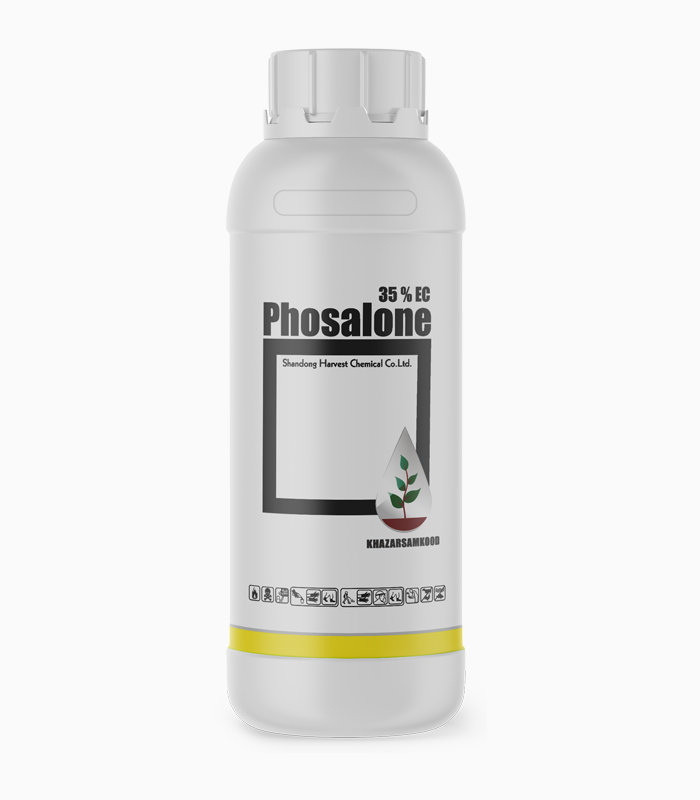
Phosalone 35% EC
It is a non-systemic insecticide and contact with ingestion mode of action. It belongs to the organophosphate, which neurotoxin acts as a cholonesterase inhibitor in the insect nervous system.
Additional information
Target and Dosage
Target and Dosage
| Crop | Pest | Dosage |
| Apple |
(Cydia pomonella) and (Anthonomus pomorum) |
1.5/1000 |
| Pear |
(Psylla pyricola), (Hoplocampa brevis) and (Anthonomus pomorum) |
|
| Plum | (Grapholitha funebrana) | |
| Quince |
(Euzophera bigella) and (Edwardsiana rosae) |
|
| Grape |
(Psalmocharias alhageos) and (Lobesia botrana) |
|
| Pistachio | (Agonoscena pistaciae) | 2.5/1000 |
| (Kermania pistaciella) | 1.5/1000 | |
| Soybean | (Helicoverpa armigera) | 2-3Lit per Ha |
| Sugar Beet |
(Chaetocnema tibialis) and (Spodoptera exigua) |
|
| Sunflower | (Spodoptera exigua) | |
| Corn |
(Rhopalosiphum spp.), (Anaphothrips spp.) and (Mythimna loreyi) |
|
| Alfalfa | (Hypera postica) | |
| Potato | (Leptinotarsa decemlineata) |
Related products

Sponsor (Spinosad 24% SC)
It is contact insecticide with ingestion mode of action. It belongs to the spinosins, whose active ingredient (spinosad) consists of two components, spinosin A and spinosin D. Sponsor is a natural substance that is produced under aerobic fermentation conditions by a soil bacterium (actinomycete) called Saccharopolyspora spinosa. And by affecting the acetylcholine receptors, it causes paralysis and death of the insect. Spinosad, with a low dosage, controls different life stages of many pests, especially the larvae of butterflies, in different products. Sponsor has good compatibility with various products (agricultural, vegetables, fruit trees etc.) and can be used in IPM.

Deltamethrin 2.5% EC
It is a non-systemic insecticide and contact with ingestion mode of action. It belongs to the pyrethroids, which disrupt sodium channels in the axon membrane and has a knock-down property that causes the insect to become paralyzed and fall quickly. Deltamethrin is used to control a wide range of pests.

Pirimicarb 50% WG
It is a systemic and contact and ingestion with fumigant mode of action insecticide. It belongs to carbamate, which is an inhibitor of the cholinesterase enzyme in the nervous system, which is destroyed by the accumulation of acetylcholine in synapses, a living insect, due to repeated stimulation and convulsions. Absorption by roots and transport in xylem.
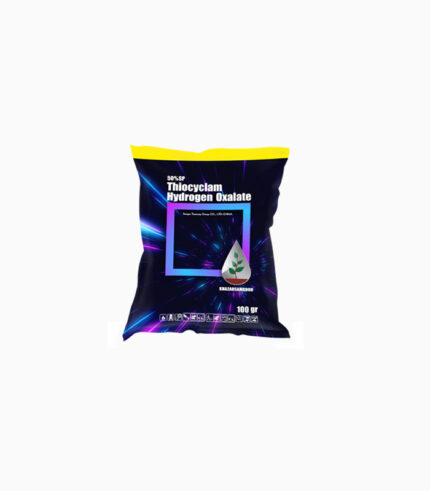
Thiocyclam Hydrogen Oxalate 50% SP
It is a selective insecticide with contact and ingestion mode of action. It belongs to the nereistoxin analogue. It has a biological origin and is prepared from a type of sea worm (Lumbrineris Heteropoda) which causes paralysis and death of the insect by blocking acetylcholine receptors in the central system.
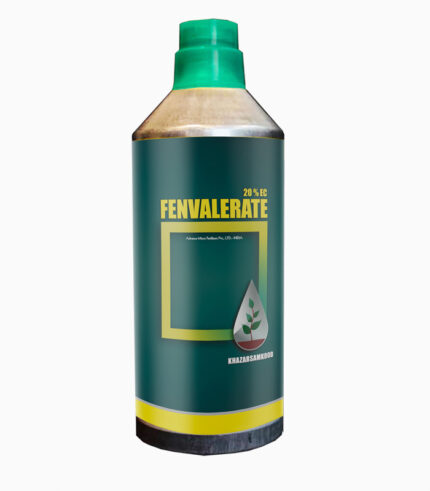
Fenvalerate 20% EC
It is a non-systemic insecticide with contact, ingestion mode of action. It belongs to the pyrethroids which disrupt sodium channels in the axon membrane and has a knock-down property that causes the insect to become paralyzed and fall quickly. Fenvalerit has a quick effect on a wide range of pests of different agricultural products.
Reviews
There are no reviews yet.